Currency markets are much larger than equity markets. By
some estimates, the daily
volume in Forex is as much as 10 times larger than the combined volume of ALL
of the world’s stock markets! So it’s a very liquid market.
Instead of THOUSAND of stocks, you just have a few
currencies.
How many stocks now trade around the world?
Within the U.S., European and
Asian stock markets, there are several dozen
industries -- at least 40 of them, give or take, each with a number of
sub-industries,
and each one of those with 100+ stocks.
So we’re talking about tens of thousands of stocks -- and you have to choose the right one!
___________________
Our History:
We were working with CoolTraderPro (automated Stock trading).
Cool Trader Pro is a private company and you basically have no recourse with them, other than suing them. I found that out the hard way.
They owe us over $20,000 and refuse to pay and then moved my sales to my up-line and didn't pay him either!
We were then looking at IML Signal Service which seemed promising
My partners and I joined IML on 9/16/2013 during the Founder's period.
I/we have been patiently and confidentially waiting since then until there was a sale-able signal service product to market. Please note that we were/are only interested in marketing the signal service and had/have no interest in marketing the educational component of IML.
We require at minimum a few months (3 or more) of successful trading results in order to promote the signal service effectively. And this is what we have been waiting for before beginning our sales and marketing efforts. Now, IML changed their requirements, if we don't elect to upgrade we will lose everything we paid $1,500 to purchase.
I feel this is grossly unfair on the part of the company and is essentially putting a gun to our head with regard to compelling us to spend yet more money before we even know if there is a viable product for us to market.
We need winning trading results are available to us. Failing that, I can only conclude that the company is acting in bad-faith and in fact, many of their trader have left! That left us high and dry!
We do think Forex has a much stronger appeal; bigger value/volume market... 24hr action and global participation... like the grand Vegas of the world.
Also, there is a long list of advantages to having a computer
monitor the markets for trading opportunities
and execute the trades.
Automated trading software is also called robotic trading minimize emotions throughout the trading process. By keeping emotions in check, traders typically have an easier time sticking to the plan.
Backtesting applies
trading rules to historical market data to determine the viability of the idea.
When designing a system for automated trading, all rules need to be absolute,
with no room for interpretation (the computer cannot make guesses – it has to be
told exactly what to do). Traders can take these precise sets of rules and test
them on historical data before risking money in live trading.
Because
the trade rules are established and trade execution is performed automatically,
discipline is preserved even in volatile markets.
Automated trading systems allow traders to achieve consistency by trading the plan. (It’s impossible to avoid disaster without trading rules). Since computers respond immediately to changing market conditions, automated systems are able to generate orders as soon as trade criteria are met.
Automated trading systems permit the user to trade multiple accounts or various strategies at one time.
Do you happen to live in or around Asheville North Carolina?
If you do, and you or someone you know is planning on painting their house anytime soon, please check out my friend's informational and Asheville painter review website at http://ashevillehousepainter.com/
THE PROVEN FOREX "MONEY MACHINE
Unlike Cool Trader Pro, 4x-dat lets you see what you are actually buying before you lay down one hard earned dollar.
You can view 6 live trading strategies to see the software in action.
You must first register to get access to software from
the following link, 4x-dat.com/profits.
Simply click on REGISTER at the bottom of the page to become an Affiliate.
An email will follow providing the prompts. (There is no obligation or virus - I promise!)
The current generation of 4X-DAT that has
recently entered the market has been consistently performing with
"hi-grade" results for about 18 months, involving estimate of 1,500 active
accounts to-date.
To create this Automated Forex Trading System, 4X-DAT has been In development
and perfecting for over 8 years with over $16 million invested; more than
50,000 man hours of programming, technical analysis, live testing, and
experimental trading; after 80,000 lines of programming code and over 200,000
hours of demo testing.
The creator has a well documented and very successful background and this new
opportunity to buy and market this software is just now being made available.
30 day, 100 percent money-back guarantee!
You can purchase with secured funds and 4x-dat also provides financing!
4X-DAT is a Publicly Traded company under the name
Global Profit Technologies Inc. (GLPT)
Recorded Opportunity presentation
https://attendee.gotowebinar.com/recording/1919253976415362306
Recorded Rewards Plan presentation
https://attendee.gotowebinar.com/recording/4298534466759806978
Spread the news!
THEN please leave a message at 240-368-7251 to find out more!
See also Forex Trading For Beginners BUT you really don't need this because this automated program DOES IT ALL FOR YOU!
  |
|
"Join The Robotic Stock Trading Revolution."
| Robotic Stock Trading is referred to
as the next generation of automated stock trading and is a form of
artificial intelligence technology . The very first robotic trading system was pioneered by founder/developer Ed Barsano and CoolTrade, Inc. This is different than simple automated systems that execute trade orders once. A true robotic trader is capable of executing a user-defined trading strategy continuously and instantaneously without any user intervention. This is what some people call "ez stock market software"! |
 We have 100% point and click (Plug & Play) ease
NO Programming is Required
No Brokerage account is required to start in DEMO mode.
Maximize profits during market advances AND declines!
Test the
built-in
strategies in real-time
Automatically Execute Your Trading Strategy; Even When
You're Away From Your Computer
Fully Test CoolTraderPro in simulation mode before you go
live!
Includes a REAL TIME simulator. Test the
system LIVE, NOW, without risking and of your money.
No experience is needed
whatsoever. You need to know
ZERO about the stock market to use this unique and powerful software.

Narang, CEO of Tradeworx said, "Humans are not involved in the trading because humans are way too slow to trade on the kinds of opportunities that we're trying to capture. We're trying to capture opportunities that exist for only fractions of a second. ...computers don't care where a stock is going to be trading next year, next month, next week or even tomorrow, because they are going to be in and out of it on the same day, in a matter of minutes." |
| CLICK for
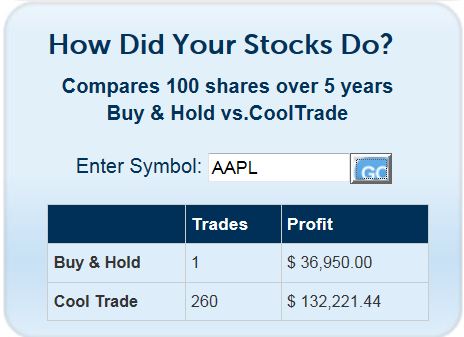
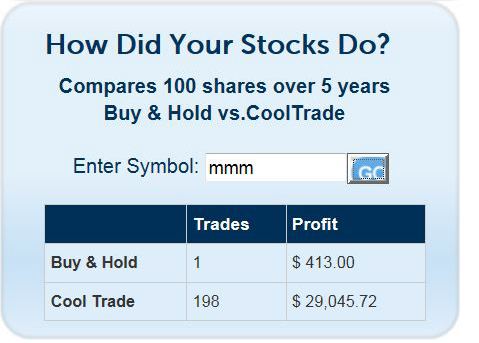
MORE Buy and Hold Stocks vs.CoolTraderPro examples - Software turns itself on during market hours - - - - Trades long or/and - Trades Short and decides when to do either - - In depth stock research tool (but you won't need it) - You can use proven strategies included in the software or create your own - Totally Point and Click. Plug and Play ease of use. - Cool Trade takes profits for you daily. - WHY and HOW CoolTraderPro works! This powerful fill-featured includes a REAL TIME simulator. Test the software system LIVE without risking and real money! No experience is needed and you don't need to know ANYTHING about the stock market to use this unique software. |
| Remember the dreadful day in May
of 2010
when the stock market DROPPED by almost 1000 points in a very short period
of time and then rocketed back up in just 30 minutes? How else could you
liquidate 81 short positions and take a profit in 20 minutes like Cool
Trade? If you weren't utilizing such a robotic trader like this one, you could not have taken advantage of this opportunity! |
Watch the video below, about Cool Trader Pro and how it did on Flash Crash Day.
WATCH
this short 1 minute video, by Ed Barsano, the creator.
| Get
the Last Copy! Purchase your copy of CoolTraderPro software before this LAST COPY IS SOLD and get the $3000.00 bonus savings package; featuring 3 YEARS subscription of FREE feeds (from early 2013 ); stock quotes and history from your brokerage house or/and CoolTrade with all of the data needed to trade using CoolTraderPro! Total value of $6000 for 1/3 off! Only $3997
33 1/3% OFF - ONLY $3997 The program alone now is $3500 and just one year of extra feeds is $1250. You get two EXTRA years for only $497! Two extra years plus the one standard year. With THIS purchase you get a total of THREE FREE YEARS of feeds. PLEASE leave a message for Ben at 828-683-8055 9am-9pm or Bob at 267-444-0164
if interested. |
|
I WAS an Independent Representative of COOLTRADERPRO |
Check out the
many trading partners that will let you utilize CoolTraderPro!


Trade Architect from TD Ameritrade. No Platform Fees or Trade Minimums!